
This post contains affiliate links. When you purchase through our links, we may earn a commission.
Have you ever tasted real Ukrainian borscht? This hearty soup is made of beef or pork stock, beets, cabbage and potatoes. If not, here is an authentic recipe that my mother and grandmother used throughout my childhood.
If you like this borscht recipe, try another Ukrainian classic Potato, Bacon and Caramelised Onion Vareniki (Pierogi).
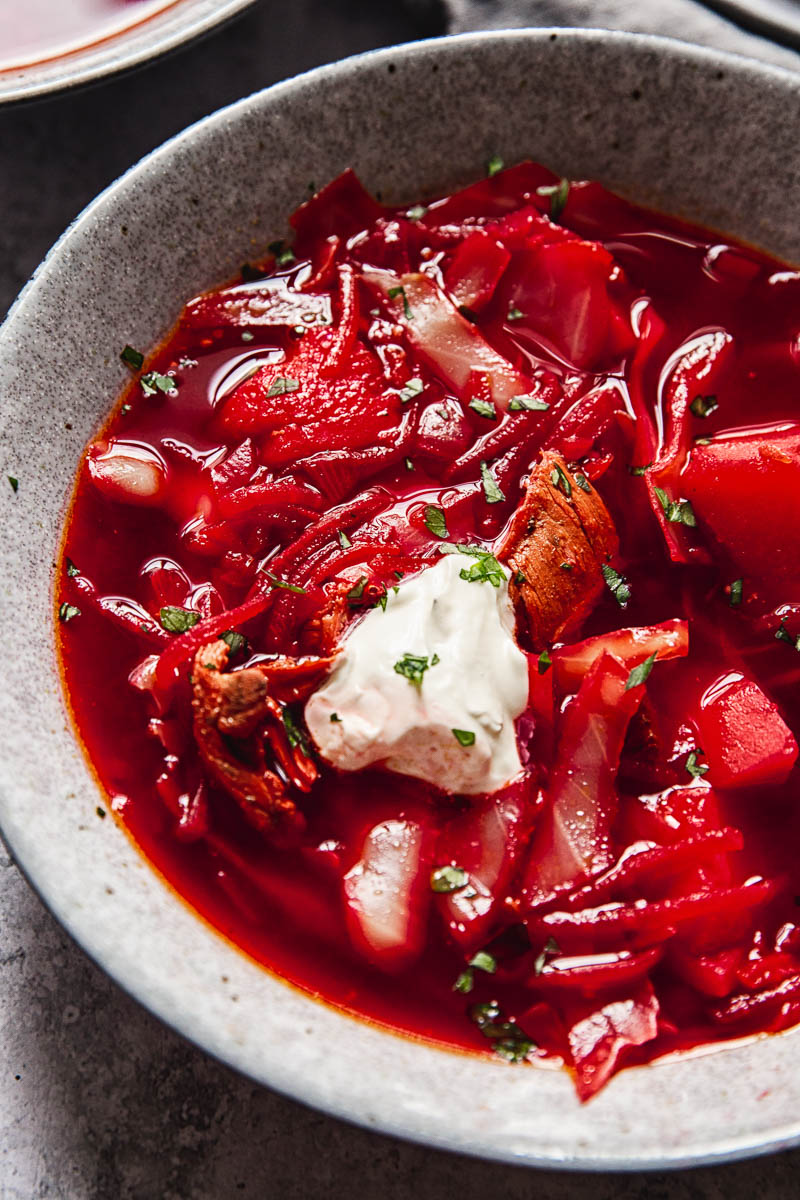
I can hardly believe I am finally sharing my family’s borscht recipe! The recipe that was at the top of my list when I first started my blog years ago.
It took me this long because BORSCHT has such a long history and an important part in Eastern European cuisine. It is a hefty task to deliver the perfect recipe, which comes with a great deal of responsibility to do it justice.
Sharing my borscht is also one of the simplest tasks because the recipe has been in my family for a few generations. It’s in my blood, very much like my Beef Stroganoff recipe or my Cabbage Rolls recipe.
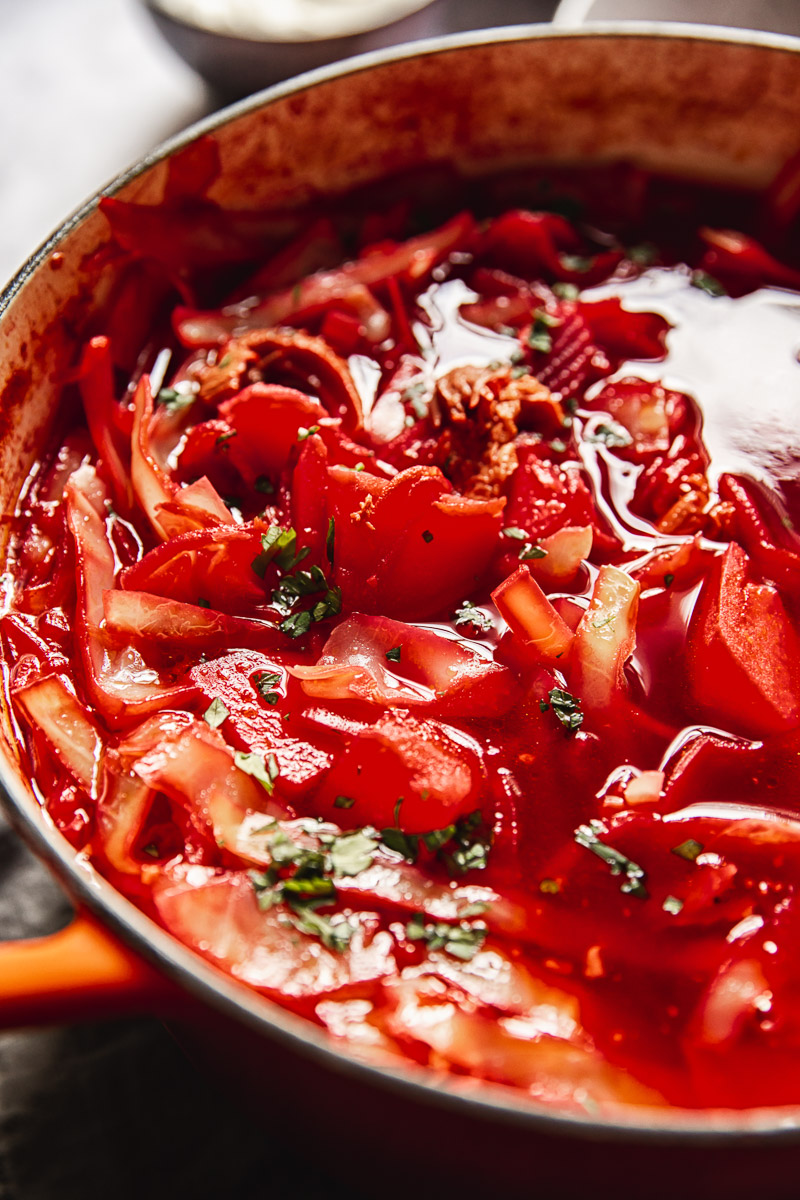
Is Borscht Russian or Ukrainian?
It’s worth clarifying pronunciation as borsch is more accurate. Yes, there is no ‘t’ at the end of the word. I know…mind blown!
And although most people associate this recipe with Russia it is actually Ukrainian. That being said, there are historical records of Russian tsars eating it centuries ago and the soup is almost as popular in Russia as it is in Ukraine.
A summer version called Green Borscht is made with sorrel. Apart from the same name, though, it is an entirely different recipe. There is also a Polish borscht and although I don’t know as much about it I know that it also features beets.
Ingredients
So what ingredients go into borscht?
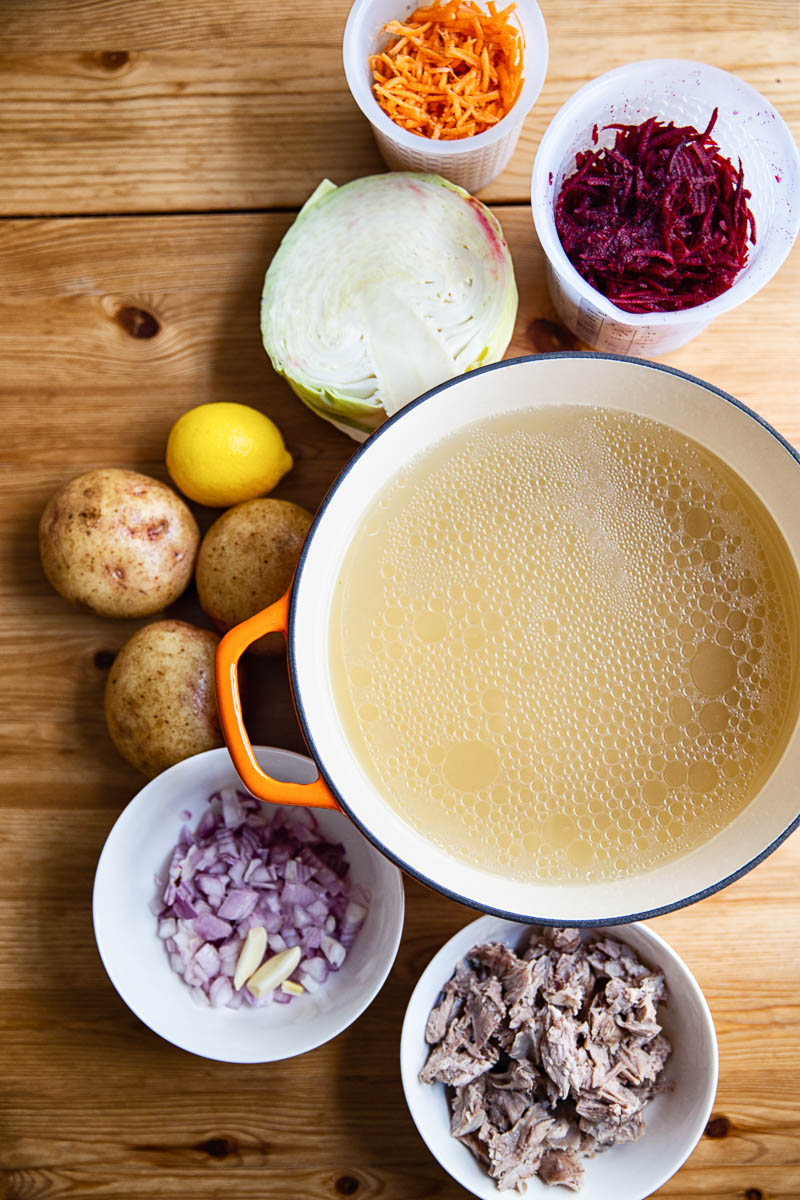
Trick question! The truth is that the recipe ingredients vary by country, region and households. However, several ingredients stay unchanged and they are the ones that make a soup into borscht.
- beets
- cabbage
- potatoes
- carrots
- onions
Traditionally there will also a little meat, such as beef, chicken or pork, with the stock will be based off one of these. However, you can work off this list ingredients to make a vegetarian borscht.
Making borscht
1. Stock
Every building needs a solid foundation and every soup starts with a great stock. Making a delicious stock is by far the most time consuming part of this recipe. It’s not difficult, it just takes time.
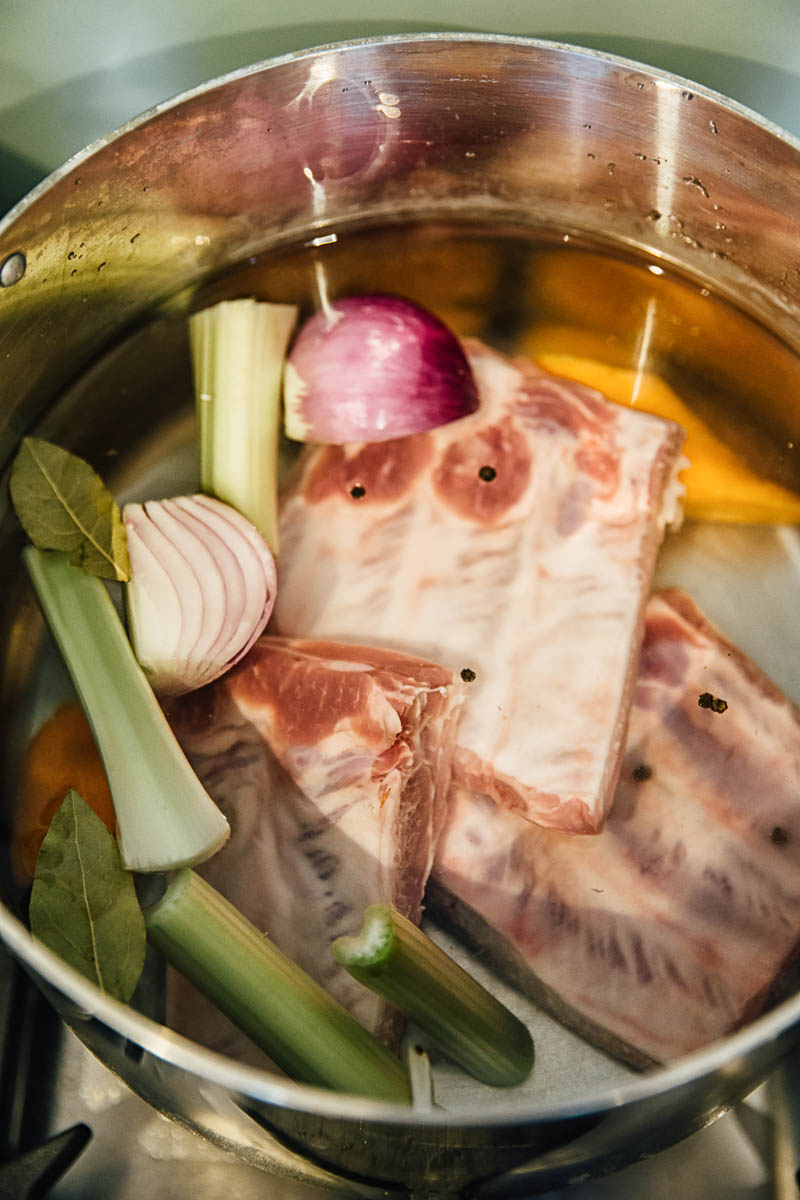
The best flavour comes from meat on a bone, simple vegetables like onions, carrots and celery and a couple of aromatics. My mother always used bay leaves and peppercorns and I do the same.
If you want to be even more authentic, use celery root for your stock instead of celery. However, I realise the root is more difficult to source outside of Eastern Europe, and that is why I included celery.
2. Soup
The soup itself takes no more than 30 minutes to make once the stock is made and clarified.
If you are short for time, I recommend making the stock the night before or even purchasing a good quality broth from a supermarket.
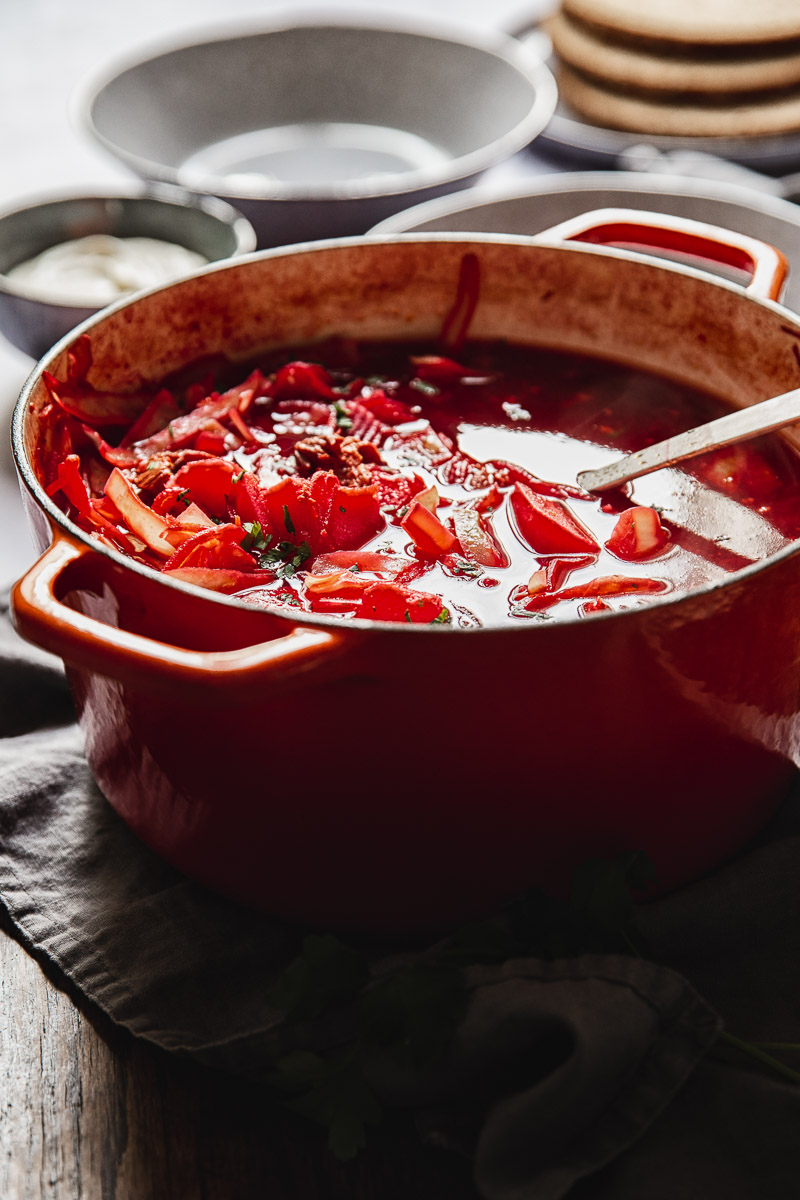
You don’t need to master specific techniques for making an authentic borscht. But you will need to add vegetables in a specific order to ensure they all get cooked to perfection in the end.
For example, cabbage doesn’t take too long to cook and therefore needs to be added last.
Lastly, grated carrots and chopped onions are always sautéed in sunflower oil or butter until soft and golden, and added to borscht towards the end. In Russian and Ukrainian cooking this method is called “zazharka“.
Many cooks do the same with beets but sautéing beets separately only adds more unnecessary steps to the recipe and doesn’t contribute anything to the flavour. I tend to skip sautéing and add raw grated beets directly to the soup.
Recipe Tips and Notes
- I prefer to make my own stock as it’s so important for the soup to have great flavour. If you are short on time or don’t want to put in the effort, use a good quality beef or chicken broth from the supermarket. If opting in for a store bought option, use 2 litres of chicken or beef stock.
- Raw beets will add the most flavour to the soup, but pre-cooked vacuum-packed beets are also a good choice. Avoid using canned beets.
- Cut potatoes in large chunks so they maintain their integrity through the cooking process.
- As I mention above, the ingredients in this soup could be varied. For example, in the summer, my mother always added red or yellow bell peppers. Some cooks love throwing in dried beans for extra protein or as a substitute for meat. Dried mushrooms are also a popular ingredient for this versatile soup.
- Borscht tastes so much better when a dollop of sour cream is added. However, do not add sour cream to the pot. Serve it on the side and allow the people to help themselves.
- Fresh herbs like parsley and dill are a traditional garnish. They add a lovely freshness and a beautiful colour to your bowl of soup.
- Raw beets will add the most flavour to the soup, but pre-cooked vacuum-packed beets are also a good choice. Avoid using canned beets.
Serving suggestions
Historically borscht is eaten for lunch as a first course followed by the second course of “meat and potatoes” in Ukraine and Russia. Although traditionally it was meat and potatoes, I put it in quotations as it could be anything other than soup. The third course is something sweet.
Although traditional, not many people have the time or appetite to eat this way anymore due to busy lives, so many have just the soup.
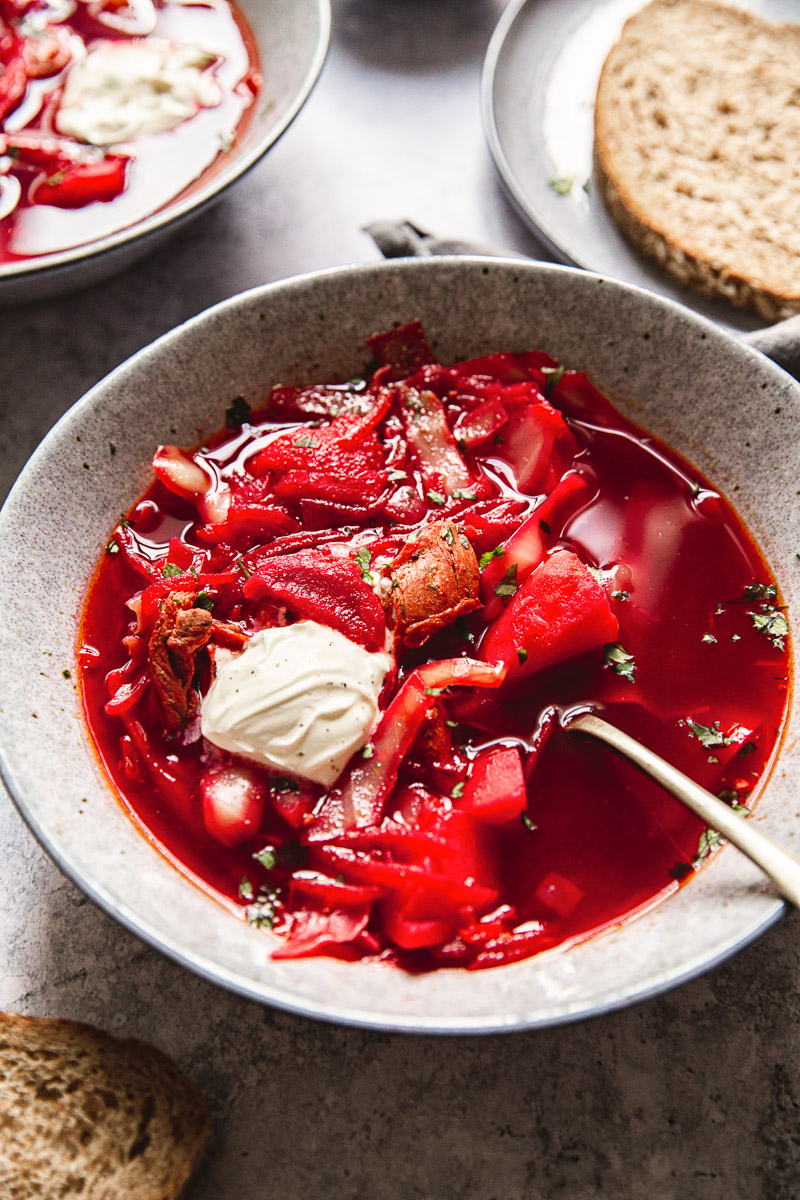
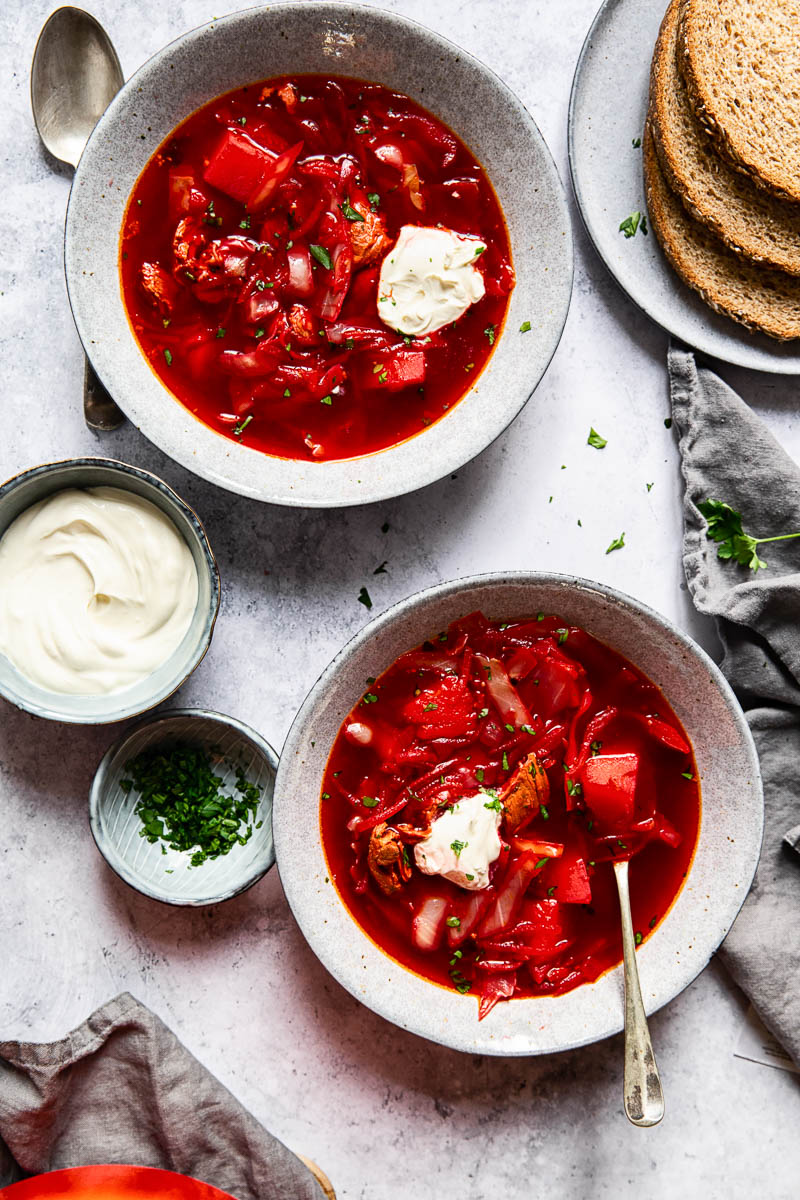
Borscht is almost always served with a dollop of smetana or sour cream and sprinkled with fresh herbs like dill or parsley. Fresh bread like sourdough or rye bread is also a permanent accompaniment to this delicious red-coloured soup.
Storage and leftovers
If the sour cream hasn’t been added, any leftover soup can be covered securely and stored in a fridge for 2-3 days. I might even recommend it, as the soup can taste better the next day after the flavours have had the chance to meld together.
Borscht can be frozen, although the potatoes won’t love freezing and defrosting and will become a bit soggy. If you do freeze, it will keep for 2-3 months.
Reheat leftovers in a microwave or in a This is an affiliate link.saucepan over medium heat.
More Eastern European soup recipes
- Restaurative Beef and Cabbage Soup ‘Shchi’
- Russian sweet and sour beef stew Solyanka
- Meatball soup
- Yellow Split Pea Soup
Borscht Recipe
Equipment
- This is an affiliate link.Stock pot
Ingredients
For the stock
- 3 litres / 3 quarts cold water, see Notes
- 600g / 1½ lbs pork ribs or beef attached to a bone
- 1/2 onion
- 1 carrot
- 2 celery sticks
- 2 This is an affiliate link.bay leaves
- 5 peppercorns
- 1 tsp salt
For the borscht
- 2 medium beets, peeled and grated
- 3 medium potatoes, peeled and cut into 2 inch chunks
- 2 medium carrots, grated
- 1 medium onion, chopped
- 2 cloves garlic, minced
- 1 This is an affiliate link.bay leaf
- 3 tbsp tomato puree/paste
- 1/2 small white cabbage, cored and sliced
- 1 lemon juice only, or 1 tsp of white vinegar
- salt to taste
- pepper to taste
Instructions
For the stock
- In a large stock pot combine water, pork ribs cut into smaller chunks to fit the pot, quartered half onion, celery sticks and carrot cut in half, bay leaves and peppercorns and a pinch of salt.
- Bring to a boil and then lower the heat to simmer for 1 hour to 1.5 hours until the meat is nearly falling off the bones. Remove the scum that floats to the top with a slotted spoon several times through the process.
- When the stock is done, let it cool slightly, then remove the ribs to a separate plate and strain the stock by pouring it over a sieve. Discard the vegetables.
- When the meat is cool enough to handle, take it off the bones and shred with two forks or by hand. Set aside until needed. Discard the bones. The stock could be made be in advance and frozen until needed.
For the borscht
- Prepare all the vegetables by peeling and grating the beets and carrots separately, chopping the onions, peeling and cutting the potatoes and slicing the cabbage. Have all vegetables ready before starting on the soup.
- Add the stock to the large soup pot, then add shredded meat, grated beets, cut into medium chunks potatoes, tomato puree, a pinch of salt and one bay leaf. Bring to a boil, then lower the heat and let it simmer.
- Meanwhile heat 1 tablespoon of vegetable oil in a pan, then add the grated carrots and chopped onions and saute over low heat for 7-10 minutes until caramelised, then add minced garlic and stir fry for 30 seconds.
- When the onions and carrots are done, add them to the soup pot together with sliced cabbage and cook for 15 minutes or until the cabbage leaves are tender but not mushy. Then add the juice of one lemon or 1 tsp of white vinegar and salt and pepper to taste.
- Serve borscht with a dollop of sour cream or creme fraiche and sprinkled with fresh dill or parsley.
Video
Notes
- Alternatively you can skip making your own stock and purchase a good quality beef or chicken broth from a supermarket. Use 2 litres/8 cups of chicken or beef stock for this recipe.
Nutrition
Nutrition information is automatically calculated, so should only be used as an approximation.










Hi I am wanting to make this recipe but have a red cabbage I wanted to use – will this work as well? Thanks
Hi Lorraine, I’ve never used it but only because it’s not very traditional. I don’t see why it wouldn’t work. Please, let me know how it goes!
When your husband who hates beets and cabbage goes back for seconds on a bowl of soup that makes no pretense about being loaded with beets and cabbage, you know you’ve made something extraordinary! Thank you for this absolute keeper of a recipe. I can’t wait to taste this in two days…
You absolutely made my day with this comment, Sara!! Love this so much!
Hi, thank you so much for this recipe, I am usually not very good when making soups but this one turned out delicious, so thank you for your guidance!
Used to live on borscht when in Russia a couple of years ago and since then, tried multiple different versions. This one is by far the best!!
Worked out even without a grater 🙂 Oh, and it came out looking just like in your picture!
I am so thrilled the recipe worked so well for you, Ida! It’s such a tasty and nourishing soup for colder days. 🙂
I’d like to know what type of onions you use and what type of beef cut as well please. The only beef on bone they had at the supermarket was porterhouse so I grabbed separate beef bones and some chuck.
Thanks in advance for feedback 🙏🏽
I used pork ribs that you see in the stock.I simply pulled meat off the bones and added it to the soup. Traditionally you wouldn’t use any prime cuts of meat, just whatever was attached to the bones you are using for stock. You can use any onion you like. I used a red one because that’s what I had but a white onion of any kind will work just as well.
With only using the meat off the bones I’m assuming this recipe isn’t supposed to be centered around meat. Or is it? If so is there any cuts you recommend to add in to increase the amount of meat to the dish? Also if choosing beef what bones should I go for? Hey thanks 🙂
Hey Philip, you are correct. The meat here is mostly to flavour the stock and plays a secondary role. If you want to make it a bit meatier, I suggest adding stewing beef or anything that is not a prime cut. Like I mention in the recipe, rib bones work great for both pork and beef as they are the easiest to source. In Ukraine and Russia it is common to use beef marrow bones for the stock. They add the most delicious flavour. If you decide to try them, going to a butcher would be the best course of action as most supermarkets don’t carry them.
Just wondering if stewing can be used to make the stick? The price of meat on bone is insane!!
Hi Laurie, do you mean stewing beef for the stock? Yes, you absolutely can! And I have done many times in the past.
I do not understand the measurement 2/2. Does that mean 2 and 1/2? Thank you for your help.
2 medium beets or 2 cups.
Thank you. I will be making this recipe this weekend.
Just like when grandma made it, Thank you
My pleasure, Pete!
Great recipe thank you for sharing!! All the best
Delicious 🥰
My husband used to do the best borscht similar recepise to this one but only secret to deep red colour is he has reserved a fresh beet juice to the end and put it in when whole soup ready and pour in the fresh beet liquid.
Hi there,
I tried this recipe. Me and my husband who is Russian loved it. It tastes so authentic and was so delicious. It’s so wholesome and healthy too. Thanks so much for this awesome recipe.
I am so glad you both loved it, Rachel!
Used a mix of home made chicken stock and a little extra made with an oxo cube, guessed at measurements somewhat and used apple cider vinegar, but turned out lovely. Never had Borscht before so couldn’t say if it tastes like it ‘should’, but it DOES taste delicious! Will keep me going for a fair number of lunchtimes! Next time (and a next time there will be) will try with some on the bone beef or pork to get more meat in it. Fantastic!
I am thrilled you loved your first borscht!! I am sure it tasted just the way it should, Chris!
Made your borscht and it was very good. First time making borscht, and my beets lost all their colour…really a dull brown soup. Did a little research and next time will reserve some beets to add at end with the lemon juice to preserve red colour.
Hi Corrine, it’s normal for beets to lose some of their colour as they give it to the rest of the soup. I am glad you enjoyed it and I hope it becomes as staple.
I have never had borscht before but was curious. I love beets and thought this might be interesting. I was stunned, this is probably now my favorite soup. I ate this for a week for lunch, so, so good. Thank you so much for this recipe, it is spectacular. I plan on making this again this month as I could eat this everyday and not get bored with it. Now on to your beef stroganoff.
Wow Peter, what an amazing outcome! Thank you for such a lovely review and enjoy! 🙂