
This post contains affiliate links. When you purchase through our links, we may earn a commission.
If you are a cheesecake fan, you definitely need my cheese Paskha recipe! It’s the prettiest and most fragrant no-bake cheesecake ever, and a traditional part of any Orthodox Easter!
For another Easter dessert, take a look at our Easy English Trifle or explore our Easter recipe collection.
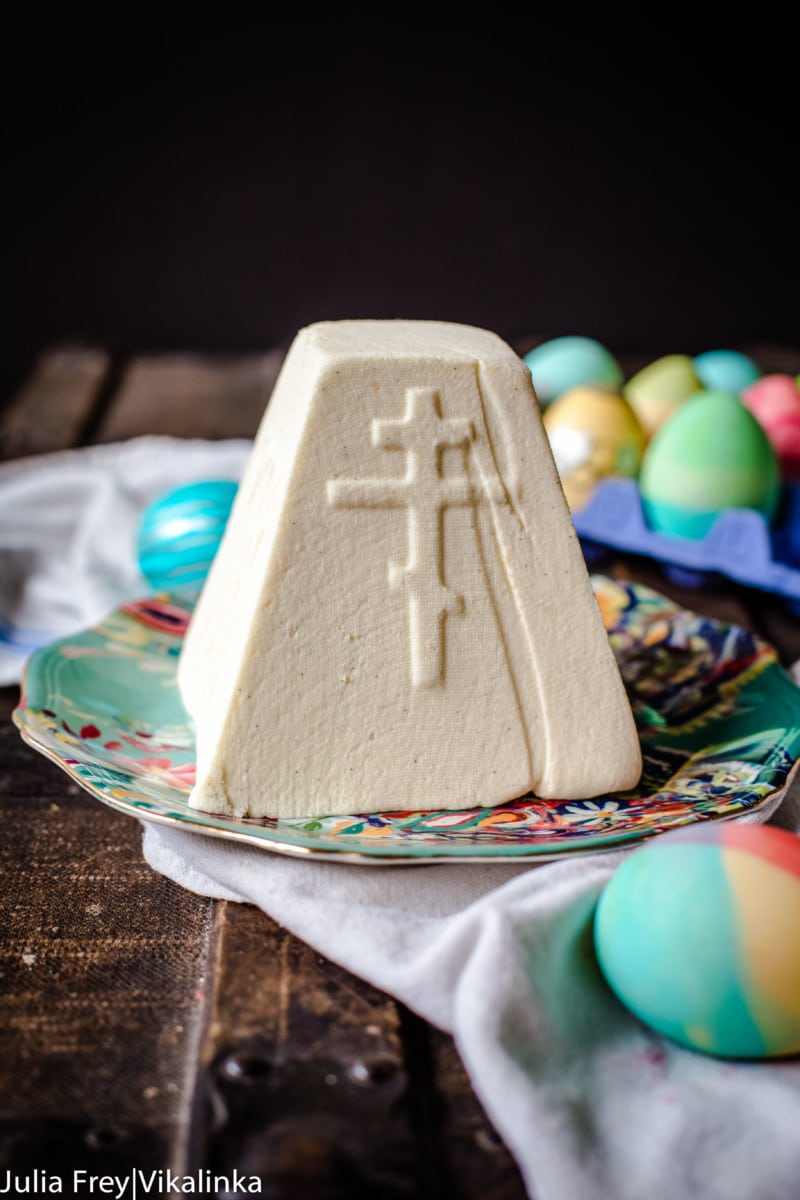
I’ve been sharing so many sweets lately. It’s not really me but when an occasion like a major holiday or a birthday calls for it I have to oblige.
This sweet cheese pudding Paskha, aka no bake cheesecake, I am sharing today is might not be that well known outside of Eastern Europe. But it is very traditional for Russia and Ukraine during the Easter holiday.
The date for Easter is a bit different in the Orthodox calendar, so this might be a bit early for some. But whenever it falls for you, Pashka will be a wonderful addition to your Easter spread, alongside Kulich and decorated eggs!
What is Paskha?
I would say paskha, sometimes spelled pashka, is a most similar to a no bake cheesecake.
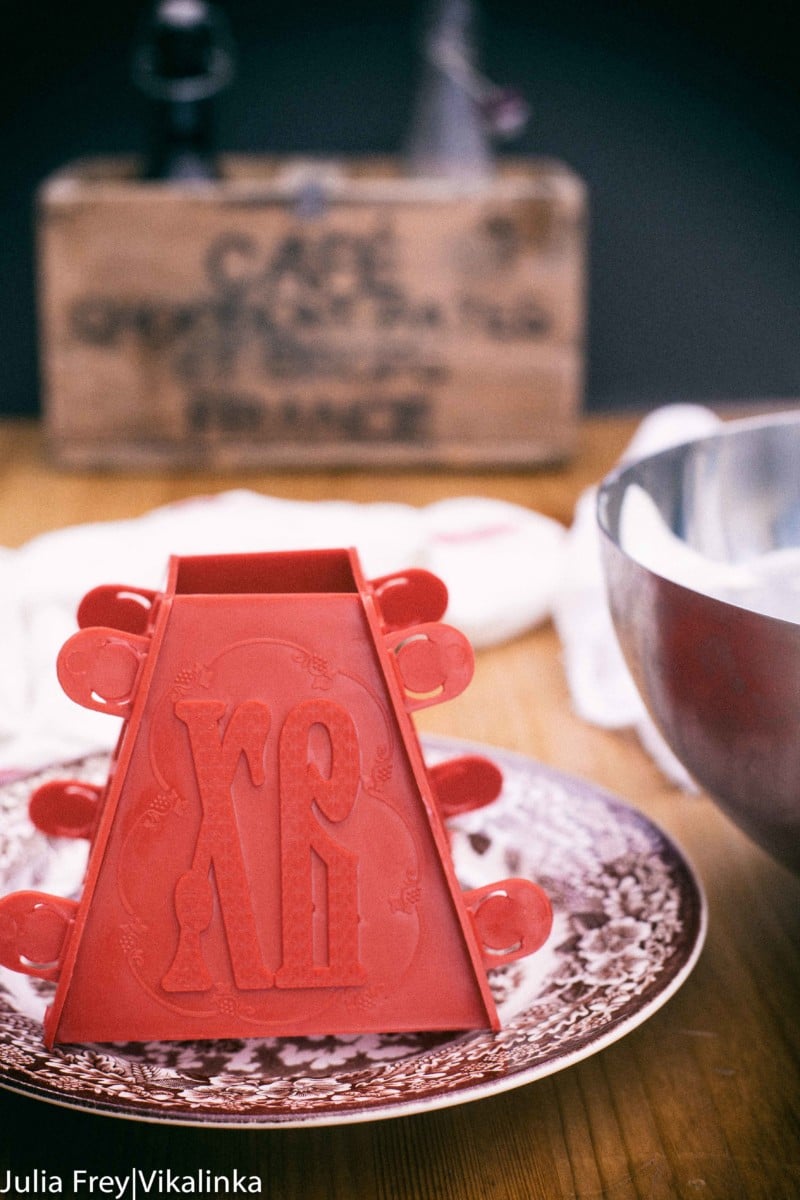
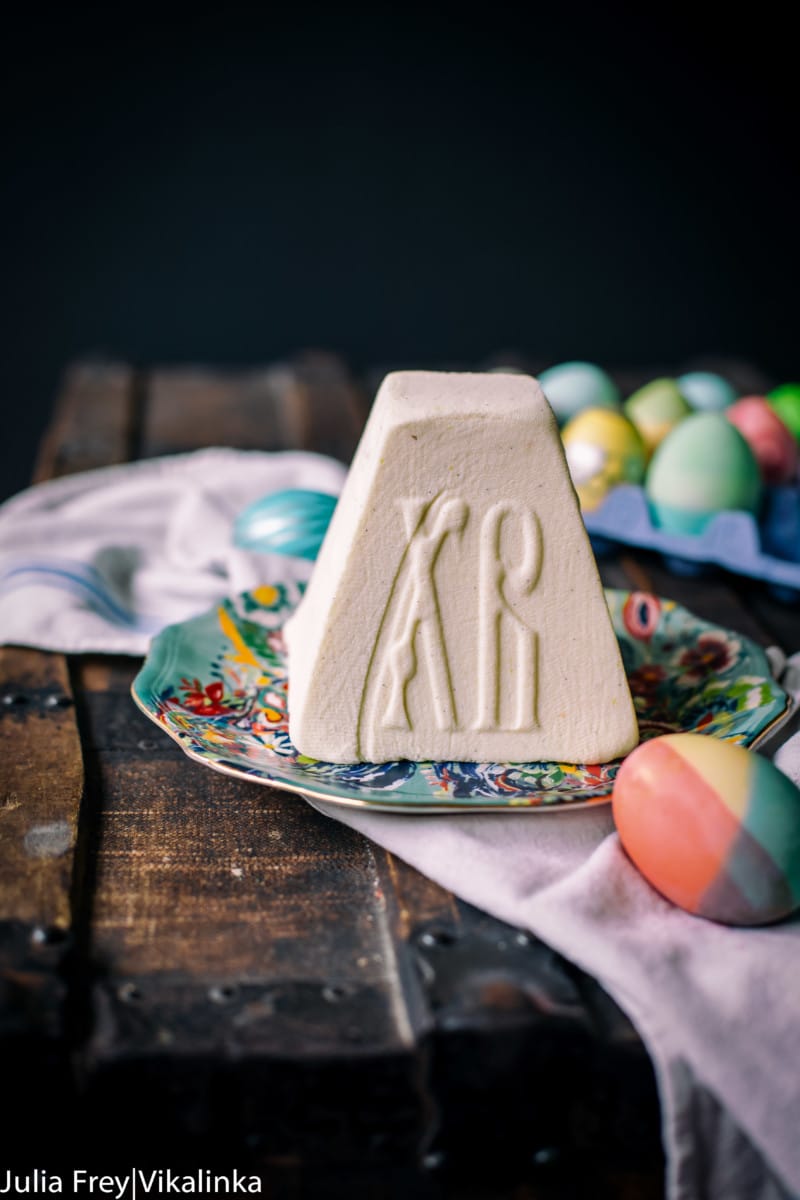
What is so cool about this dessert is the mold it’s made in, which gives it this unusual shape. The mold is traditionally made out of wood and not so easy to come by nowadays.
I’ve wanted to make and blog this recipe ever since I started Vikalinka but I didn’t know where to look for the mold. Turns out it isn’t actually that hard to find, with plenty of online shops offering, which is how I sourced mine.
It worked absolutely beautifully! It’s also more practical than a wooden one for rainy England where things tend to go moldy! (Pun intended)
How to make it
Traditionally this cheese pudding is made with a blend of farmer’s cheese, called Tvorog in Russian, fresh eggs, sugar and dried fruit and nuts. However I modified the recipe by omitting the eggs for food safety reasons and ditching dried fruit and nuts for “we hate them” reasons.
Fine, I don’t hate all dried fruit and I definitely don’t hate nuts. But I don’t like them in baked goods. I also think the texture of this cheese pudding, which is like a cheesecake, clashes with fruit and nuts.
To compensate for those ingredients I added vanilla bean, crème fraîche and lemon zest and juice. We absolutely loved the result, served with blackcurrant preserve my paskha still tasted very authentic and crazy delicious!
Farmer’s cheese (or tvorog)
If you are not familiar with farmer’s cheese you should definitely give it a go. It’s very similar to Italian Ricotta but has slightly bigger curds and a little bit of a tang.
In the UK I was able to find it at major supermarkets as well as local Eastern European shops. It’s also easy to make your own, as in the Tvorog recipe from Natasha’s Kitchen.
Recipe Tips and Notes
- Traditionally paskha is made with added ingredients like candied fruit, nuts and raisins, but in my house we prefer it with just vanilla. Mix any additions into the cheese when adding other ingredients.
- Paskha is traditionally made as a tall pyramid with Christian symbols, memorialising the pyramids of Egypt and the first passover. Molds can be easily be found online or in many Eastern European shops. I ordered mine on Etsy and it was shipped from Ukraine.
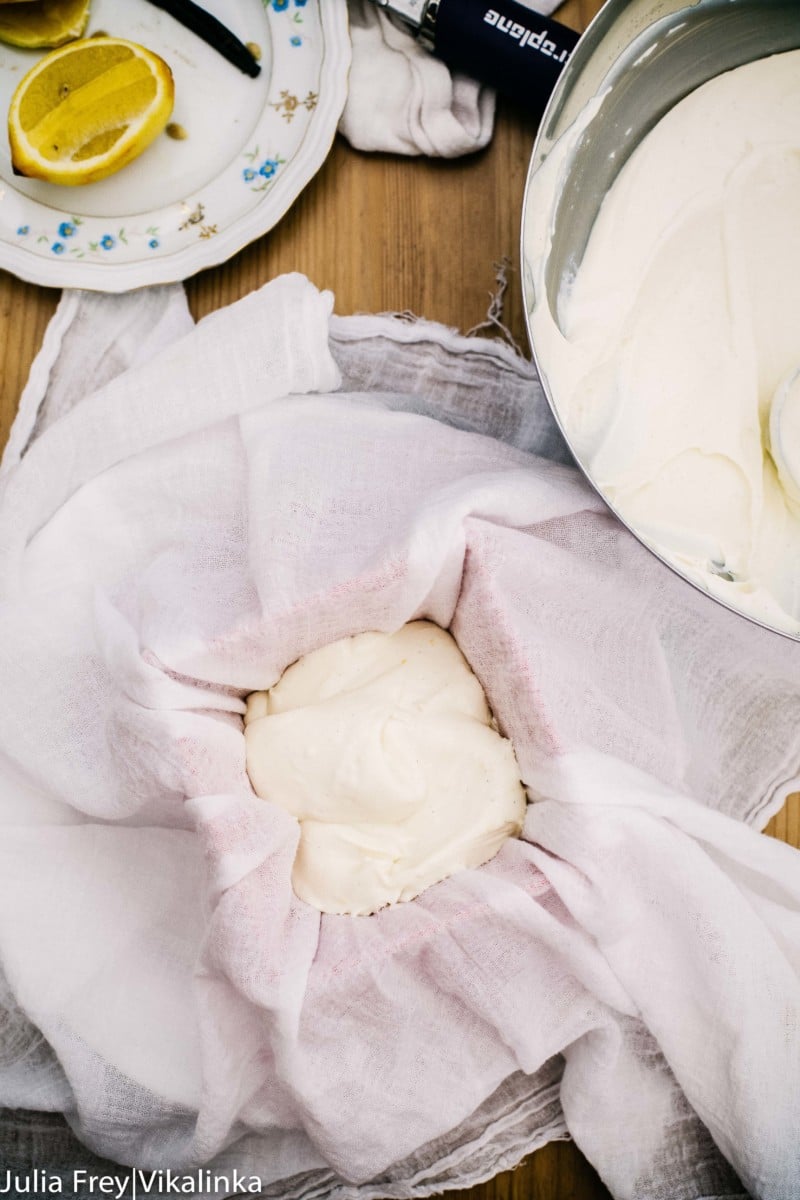
- It’s important to pack the cheese mixture tightly into the mold in order to prevent air bubbles. A loosely packed paskha will not be firm enough to stand on its own and will not have the firm lines that are important for the aesthetic.
- Cheesecloth is also an important element in this process. It absorbs some of the moisture from the cheese and helps create the desired shape and structure.
- Since it is a dairy product I recommend to refrigerate any leftovers.
Serving suggestions
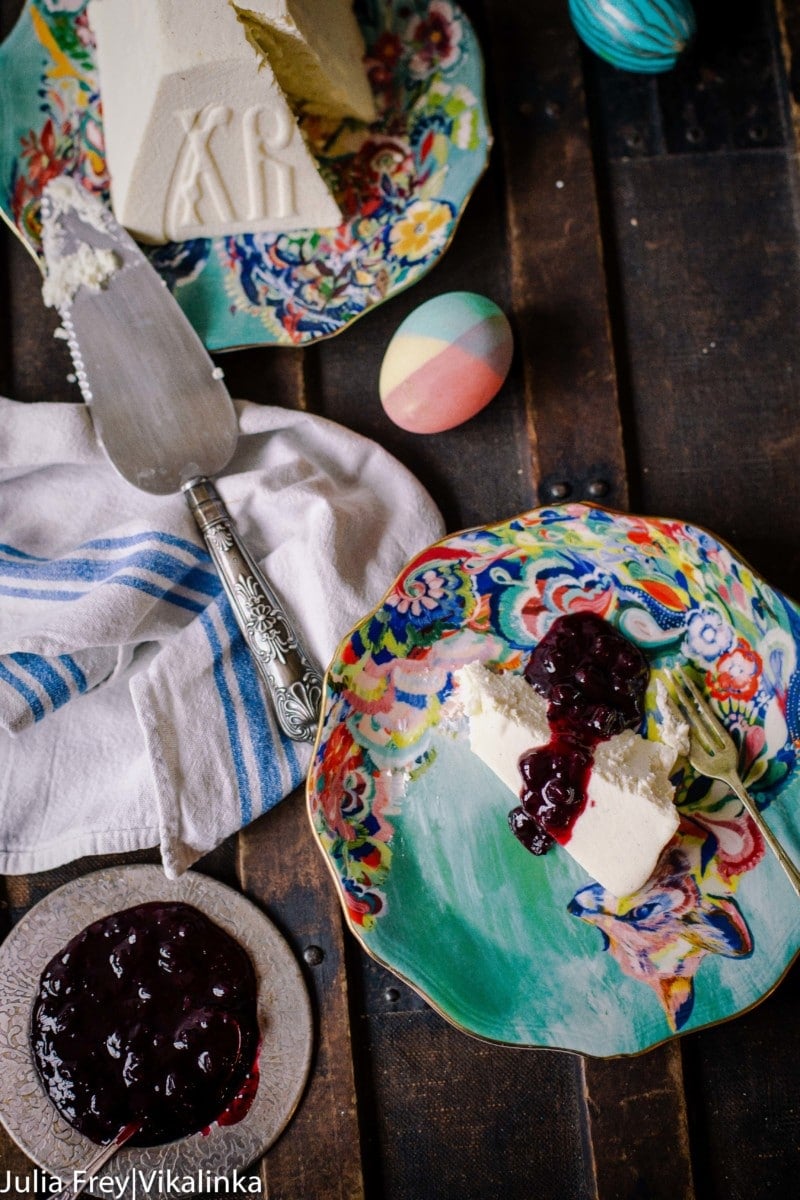
With its tall structure, it might not be immediately obvious how to serve it, but it’s really quite simple. Just pull out a slice as you would any other cake or loaf.
The best way to eat Paskha is slathered on a thick piece of crusty bread, but I like it on its own as well. It’s truly wonderful with an added dollop of jam.
Storage and leftovers
Paskha, like other unbaked cheesecakes, should be covered in plastic or added to an This is an affiliate link.airtight container if you have one large enough. It can be stored in a refrigerator for 4-5 days.
Wrapped in plastic wrap first, and aluminium foil after, and you can freeze paskha for up to three months. Let it fully thaw in a refrigerator before serving.
More Easter treats
- Lemon Vanilla Posset
- Carrot Cake with Cream Cheese Frosting
- Lemon Curd Cheesecake
- Basque Cheesecake with Raspberry Compote
- Lemon and Poppyseed Hot Cross Buns
Sweet Cheese Pudding ‘Paskha’
Ingredients
- 1.4 kg / 3lbs farmer's cheese Tvorog
- 175ml / 3/4 cup crème fraîche or sour cream, full fat
- 150g / 2/3 cup unsalted butter
- 300g / 1½ cup sugar
- 1 vanilla bean, seeds scraped out
- 1 lemon, zest and juice
Instructions
- Zest a lemon and juice it, split the vanilla bean and scrape out seeds.
- In a food processor combine farmer's cheese, crème fraîche, softened butter, sugar, vanilla bean seeds and zest and juice of one lemon. Process until silky smooth.
- Turn the Paskha mold upside down and set inside a bowl, line it with cheese cloth so the ends are long enough to cover the bottom of the mold. Transfer the cheese mixture into the mold, pack it tightly to avoid air bubbles.
- Cover the top with cheese cloth and set a plate on top of, which then should be weighed down with something heavy like a mason jar filled with water.
- Refrigerate for at least 10 hours. When the cheese pudding is ready to be unmolded you should see some liquid from farmer’s cheese at the bottom of the bowl. This means the cheese pudding is sufficiently drained and will be able to hold its shape.
- Uncover the base of cheese pudding from the cheese cloth and place a plate directly on top of cheese, then invert the cheese pudding while still in the mold onto a serving plate, gently pull the mold off the cheese pudding and then remove the cheese cloth.
- Serve with any fruit preserves and whipping cream if desired.
Nutrition
Nutrition information is automatically calculated, so should only be used as an approximation.









I have a complicated paskha recipe I have made for years each Holy Friday in preparation for Pascha. And each year, I press it into my very old wooden paskha mold. Imagine my delight at finding your much easier recipe! I did still make my own tvorog; however, I used your recipe for the paskha. Thank you for saving me so much time and trouble!
I am thrilled to hear it! Happy Easter!
I, too, leave the Dried fruits out of our pashka. None of us really care for them. They don’t make it into our kulich, either! This looks wonderful. Now that I actually live in Russia, I’m looking forward to making this with real tvorog. I always had to substitute when I lived in the US.
Thanks Sara! Tvorog is readily available in London. I buy a Polish brand and it’s delicious. 🙂
My uncle used to make this for Easter (my grandmother and great-grandmother were born in St Petersburg and Riga, respectively). In the absence of a mold he would always use a clean terracotta flowerpot lined with muslin. His would have been beautifully decorated with candied fruit and almonds. I had a go last Easter. Lovely memories.
It’s so lovely for you to keep the tradition going! 🙂
After 31 years in the Orthodox church, learning all about the various customs and foods, I finally found a paskha recipe that even my Russian friends would be proud to serve. Thank you! And I made my own tvorog too. I used a wooden paskha mold that my husband was given many years ago on a trip to the USSR by his generous host. It must be a hundred years old.
Thank you for sharing that, Nancy. I am thrilled you loved this Paskha recipe.
This is such a beautiful paskha! I love that it’s no bake cheese pudding and that mold is absolutely beautiful.
What a delicious Easter treat! I love how you left out the dried fruit. I also don’t like the texture of dried fruit in paskha.
What would be the best thing to make this paskha in if you didn’t have one of the special moulds please?
Hi Alli, great question! If you want to preserve the original shape you can make it on a new flower pot. The hole at the bottom is great for draining excess liquid. Otherwise, you can always make Paskha in a springform pan. Just make sure you drain the cheese first in order for it to set properly. Good luck!!
Amazing
We call it as a pasha in Finland. And its quite traditional treat during Easter. Your pasha looks wonderful! I love your fox plates.
Love this! Always love learning about different cultural foods 🙂